
 See My Latest Article on HelloNation
For residents of Williamsville, NY, choosing a ballroom dance style often begins with a simple question: Which dances are most popular, and how are they different? The answer depends on whether the goal is social dancing, formal competition, wedding choreography, exercise, or learning a dance that feels comfortable and expressive.
Ballroom dancing is usually divided into two broad families: Standard or Smooth dances, which travel around the floor, and Latin or Rhythm dances, which often use more compact footwork, pronounced musical accents, and expressive hip or body movement.
What are the main types of ballroom dancing?
The most widely recognized ballroom styles are Waltz, Foxtrot, Tango, Quickstep, Viennese Waltz, Cha-Cha, Rumba, Swing, Samba, and Jive. Some are commonly taught for social dancing, while others are associated more strongly with formal competition.
A dance’s popularity may also depend on the setting. A wedding reception may call for a simple Waltz or Foxtrot. A social dance event may include Swing, Cha-Cha, or Rumba. Competitive ballroom programs often teach a defined group of dances with specific technique, timing, and styling.
Which Smooth and Standard dances are most popular?
Smooth and Standard dances generally use a shared frame between partners and are designed to move around the dance floor.
Waltz
The Waltz is one of the most recognizable ballroom dances. Its flowing three-beat rhythm gives it a graceful, circular quality, and its basic timing is often counted as “one, two, three.”
The dance is popular for:
- Formal social events
- Wedding receptions
- Anniversary celebrations
- Beginners who enjoy slower, elegant music
Traditional Waltz travels around the room with sweeping turns and rising-and-falling movement. It can look complex, but introductory lessons usually begin with a manageable box step and simple turns.
Foxtrot
Foxtrot is known for smooth walking steps, controlled weight changes, and relaxed musical phrasing. It is often danced to jazz, swing, or big-band music and can feel natural because many of its movements resemble ordinary walking.
Foxtrot is useful for dancers who prefer:
- A comfortable, conversational rhythm
- Classic formal-dance styling
- Moderate movement around the floor
- Music with a steady, polished character
Its timing may include slow and quick steps, which creates a smooth, flexible quality rather than a strongly accented pattern.
Tango
Tango has a more dramatic character than Waltz or Foxtrot. Its movement is often grounded, precise, and direct, with sharp changes in direction and a strong connection between partners.
There are several forms of Tango. Ballroom Tango is structured for traveling around a dance floor, while Argentine Tango is generally more improvisational and emphasizes close listening between partners. They share a name but are not interchangeable styles.
Tango appeals to people who enjoy:
- Strong musical accents
- Deliberate pauses
- Compact, controlled movement
- A dramatic or theatrical mood
Quickstep and Viennese Waltz
Quickstep is a lively traveling dance with brisk footwork, small jumps, and energetic changes of direction. It is typically more demanding than slower ballroom styles because dancers must maintain posture and partnership while moving quickly.
Viennese Waltz is faster than the more familiar slow Waltz. It uses continuous turning and requires good floor awareness, especially in a crowded room. Both dances are popular in formal ballroom study but may be introduced after a dancer has developed basic balance, timing, and partner connection.
Which Latin and Rhythm dances are most popular?
Latin and Rhythm dances are often more compact than traveling ballroom dances. They may be danced in place or within a smaller area, which can make them practical for crowded receptions and social gatherings.
Cha-Cha
Cha-Cha is playful, rhythmic, and easy to recognize by its triple-step pattern. It is often chosen by beginners because the music has a clear pulse and the dance encourages lively expression.
It works well for:
- Social dance events
- Wedding receptions
- Upbeat Latin music
- Dancers who enjoy clear rhythmic patterns
Good Cha-Cha technique involves more than simply moving the hips. Timing, weight transfer, posture, and relaxed footwork all help the movement look natural.
Rumba
Rumba is slower and more expressive than Cha-Cha. It emphasizes controlled weight changes, Cuban-style motion, and communication between partners. The dance is often associated with romantic music, making it a frequent choice for wedding choreography.
Rumba can be a useful starting point for couples who want a first dance that feels intimate without requiring rapid steps. Its slower tempo also gives beginners more time to think about posture, direction, and connection.
Swing
Swing is one of the most adaptable social dance families. East Coast Swing is often taught to beginners because it uses a compact six-count pattern and works with many types of upbeat music. Other forms, such as West Coast Swing and Lindy Hop, have their own timing, styling, and musical interpretation.
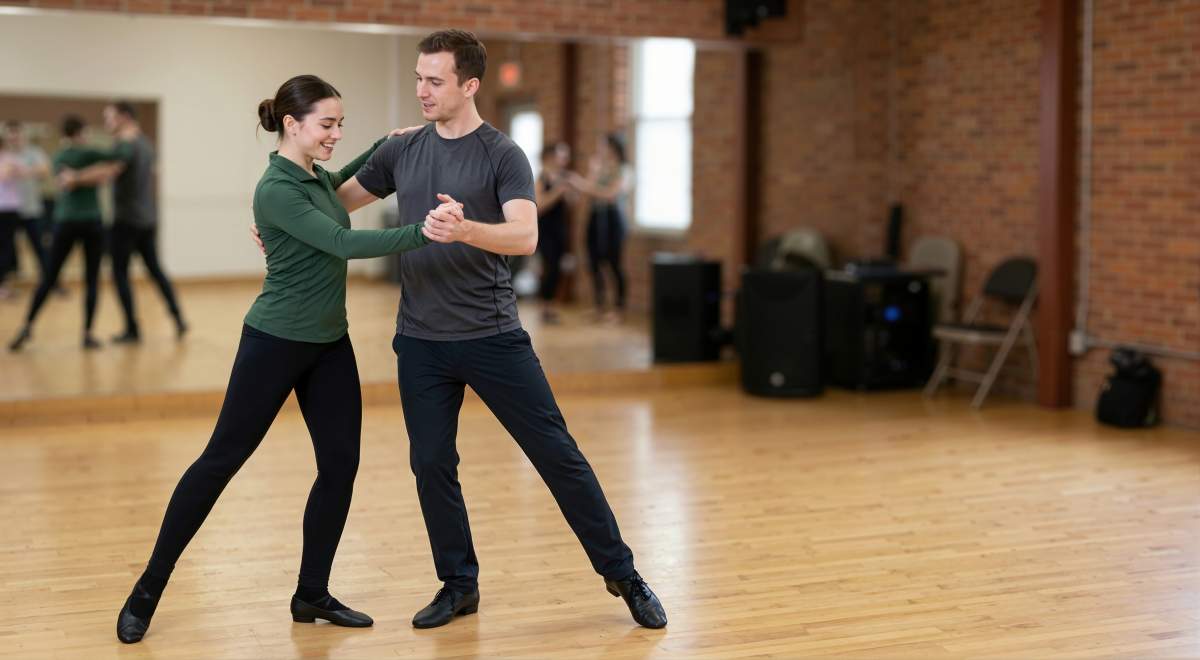
Swing is popular because it is:
- Energetic without requiring a large dance floor
- Adaptable to different songs
- Social and improvisational
- Suitable for casual celebrations
In the winter months, indoor social dancing can be especially appealing in a region where cold temperatures and snow may limit outdoor activities. A compact dance such as Swing can also work well in a home practice area when furniture is moved aside.
Samba and Jive
Samba has a buoyant rhythm and distinctive pulsing action. It is often studied in competitive Latin programs and requires careful control of the body and feet.
Jive is fast, springy, and energetic. It includes quick kicks and changes of weight, making it physically demanding for many beginners. Both dances are popular among dancers who want a challenge, though they are often introduced after foundational timing and balance have been developed.
What is the best ballroom style for a wedding?
There is no single best wedding dance style. The right choice depends on the song, the available floor space, clothing, footwear, and how much time the couple wants to spend practicing.
For a first dance, common choices include:
- Waltz for a graceful, formal song
- Foxtrot for a smooth, classic feel
- Rumba for a slower and more romantic mood
- Cha-Cha for a playful, upbeat song
- Swing for an energetic reception
- A customized combination for songs that change tempo or style
A wedding routine does not need to be highly complicated to look polished. A few well-practiced elements—such as an opening pose, a turn, a change of direction, and a final position—can create a complete performance without adding unnecessary risk.
Couples should also consider seasonal clothing and venue conditions. Formal shoes, long dresses, winter layers, and limited indoor space can affect balance and movement. Practicing in footwear similar to what will be worn at the reception can make the final routine feel more predictable.
Is ballroom dancing difficult for beginners?
Most ballroom styles can be learned at a beginner level, especially when instruction begins with rhythm, posture, weight transfer, and basic partner communication. Difficulty increases when dancers add faster tempos, complex turns, styling, or traveling patterns.
Common beginner challenges include:
- Moving before hearing the beat
- Taking steps that are too large
- Looking down instead of maintaining posture
- Treating the lead-and-follow connection as a rigid push or pull
- Practicing steps without learning how to stop safely
Progress is usually more consistent when dancers focus on timing and balance before trying elaborate choreography. A simple routine performed comfortably often appears more confident than a difficult routine performed with hesitation.
How can someone choose among popular styles?
Start with the music and purpose. People preparing for a wedding may choose a style that matches the first-dance song. Social dancers may prefer Swing, Cha-Cha, or Foxtrot because these styles appear in many informal and formal settings. Those interested in graceful movement may enjoy Waltz, while dancers drawn to drama may prefer Tango.
Trying several styles can also reveal differences that are difficult to understand from descriptions alone. The most suitable dance is usually the one whose rhythm, movement quality, and level of physical challenge feel enjoyable and realistic for the individual or couple.